No, the Great Wall of China is not visible from space
Astronauts have said it for decades and the optics confirm it. At 400 kilometers up, the Great Wall is roughly ten times too narrow for the human eye to resolve, and its color barely stands out from the ground around it.
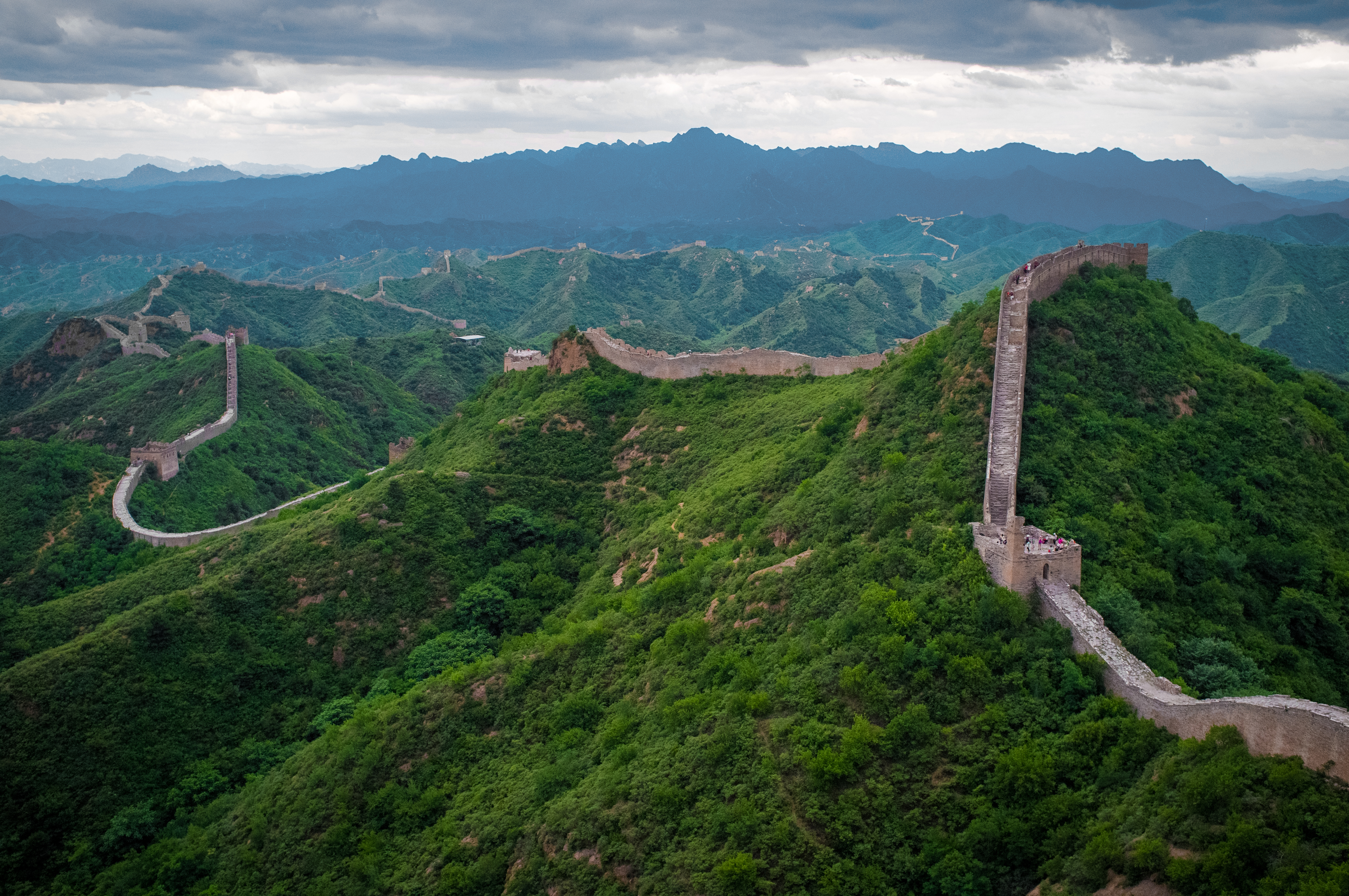

The gist. The claim that the Great Wall of China is visible from space, or even from the Moon, with the naked eye is false. At low Earth orbit the wall is about ten times narrower than the human eye can resolve, and its stone blends into the surrounding terrain. Every astronaut who has looked for it agrees.
Ask a classroom which human structure can be seen from space and most hands go up for the same answer, the Great Wall of China. It is one of the stickiest facts that is not actually a fact, repeated in textbooks, trivia nights and even some museum placards. The physics of the human eye settles it in a couple of lines of arithmetic.
Where the claim came from
The earliest known version predates spaceflight by two centuries. English antiquarian William Stukeley speculated in a 1754 letter that a wall so massive "might likely be seen from the moon." The idea resurfaced in 1938 in Richard Halliburton's bestselling Second Book of Marvels, which stated flatly that "astronomers say" the wall was the only human made object visible from the Moon, without naming a single astronomer. No telescope of the era could have tested that claim either way, which did not stop it from becoming folk wisdom repeated for generations before anyone left the atmosphere to check.
What astronauts actually report
Once humans could look for themselves, the answer came back consistently negative. Apollo 11's Neil Armstrong said the wall is "definitely not visible from the Moon" to the naked eye. China's first taikonaut, Yang Liwei, told reporters in October 2003 that "the Earth looked very beautiful from space, but I did not see our Great Wall," as reported by BBC Sky at Night Magazine. Former NASA astronaut Jeffrey Hoffman, who spent hundreds of hours looking down at Earth across five shuttle missions, put his finger on the second reason it fails, not just size, color. "The human eye is most sensitive to contrast, and the color of the wall is not that different from the ground on either side of it," he told Scientific American. Much of the wall is rammed earth and local stone, the same tan and gray palette as the terrain it crosses.
The sky never sleeps.
Eclipses, meteor showers, launches… Every Sunday I send you the week’s sky events you can’t miss. Free.
The arithmetic that settles it
The human eye's angular resolution, its ability to separate two points as distinct rather than a single blur, tops out around one arcminute under good conditions, a limit set by the spacing of photoreceptor cells on the retina and confirmed in countless optometry studies. One arcminute is 1/60 of a degree, or about 2.9 x 10⁻⁴ radians.
The Great Wall's widest sections run about 9 to 10 meters across. The International Space Station orbits roughly 400 kilometers, 400,000 meters, above the ground. Divide the wall's width by that distance and you get its angular size as seen by an astronaut looking straight down, 10 / 400,000 = 2.5 x 10⁻⁵ radians, which converts to about 0.086 arcminutes.
Flip the calculation around to find how wide an object would need to be to clear the eye's one arcminute threshold from that altitude, multiply the resolution limit by the distance, 2.9 x 10⁻⁴ radians times 400,000 meters is about 116 meters. The wall would need to be more than ten times wider than its actual 9 to 10 meters before an unaided eye in orbit could resolve it as a line at all, and that is before accounting for Hoffman's point about weak contrast, which makes the effective threshold even worse. From the Moon's distance of about 384,000 kilometers, the same 10 meter wall subtends an angle nearly a thousand times smaller still, arithmetic so lopsided that no plausible human eyesight closes the gap.
What you actually can see from orbit
None of this means human structures are invisible from space, some are just wider or higher contrast than a defensive wall. NASA has photographed and catalogued the Three Gorges Dam, over 2.3 kilometers long, from the ISS, and astronauts routinely photograph city lights, large airports, and agricultural field patterns that span kilometers rather than meters. The Great Wall itself is photographable, astronaut Leroy Chiao captured it from the ISS in 2004, but only with a telephoto lens, the same kind of equipment that turns an indistinct smear into a resolvable structure precisely because a lens can gather and magnify light in a way the naked eye cannot.
Frequently asked questions
Can astronauts see the Great Wall of China from the International Space Station?
Not with the naked eye. At about 400 kilometers up the wall is roughly ten times narrower than human vision can resolve, and photographs of it from orbit have all required telephoto lenses.
Is the Great Wall visible from the Moon?
No. At the Moon's distance, about 384,000 kilometers, the wall's angular size shrinks to a small fraction of what it is from low Earth orbit, making it far less visible than it already isn't from the ISS.
Who started the myth?
The earliest trace is a 1754 letter by English antiquarian William Stukeley. It was popularized in 1938 by traveler Richard Halliburton, who attributed the claim to unnamed "astronomers."
What human structures actually are visible from orbit?
Wide, high contrast features like the Three Gorges Dam, major airports, city lights at night and large agricultural field patterns are all identifiable from the ISS, because their size or brightness clears the eye's resolving threshold in a way the Great Wall's narrow, low contrast stone does not.
Sources
- Scientific American, No, You Can't See the Great Wall of China From Space
- NASA, image article on the Great Wall of China photographed from the ISS
- NASA Earth Observatory, Three Gorges Dam, China
- BBC Sky at Night Magazine, Can you see the Great Wall of China from space?
- Wikipedia, Richard Halliburton
The sky never sleeps.
Eclipses, meteor showers, launches… Every Sunday I send you the week’s sky events you can’t miss. Free.